
The Importance of Unity
Unity Strengthens Our Fire Community
The strength of a fire service is not measured by how many departments, stations, or firefighters it has—it is measured by how well they work together. True unity requires common standards, shared training, clear leadership, and trust in the firefighter standing beside you. When lives are on the line, there cannot be “us” and “them.” There must only be one fire service, working toward one mission: protecting our community.
Understanding Fire Service Divisions
Ten departments may share a response area, but that does not automatically make them one fire service. Unity requires more than responding to the same emergencies. It requires common standards, coordinated training, clear accountability, shared resources, and one chain of command.
Our community deserves a fire service designed around how we respond to emergencies today—not a fragmented system built around organizational boundaries of the past.
One community. One standard. One chain of command. One fire service.
Because when someone's home is burning, when a family is trapped, or when a firefighter needs help, there should be no distinction between “ours” and “theirs.” There should only be us.
WHY UNITY MATTERS
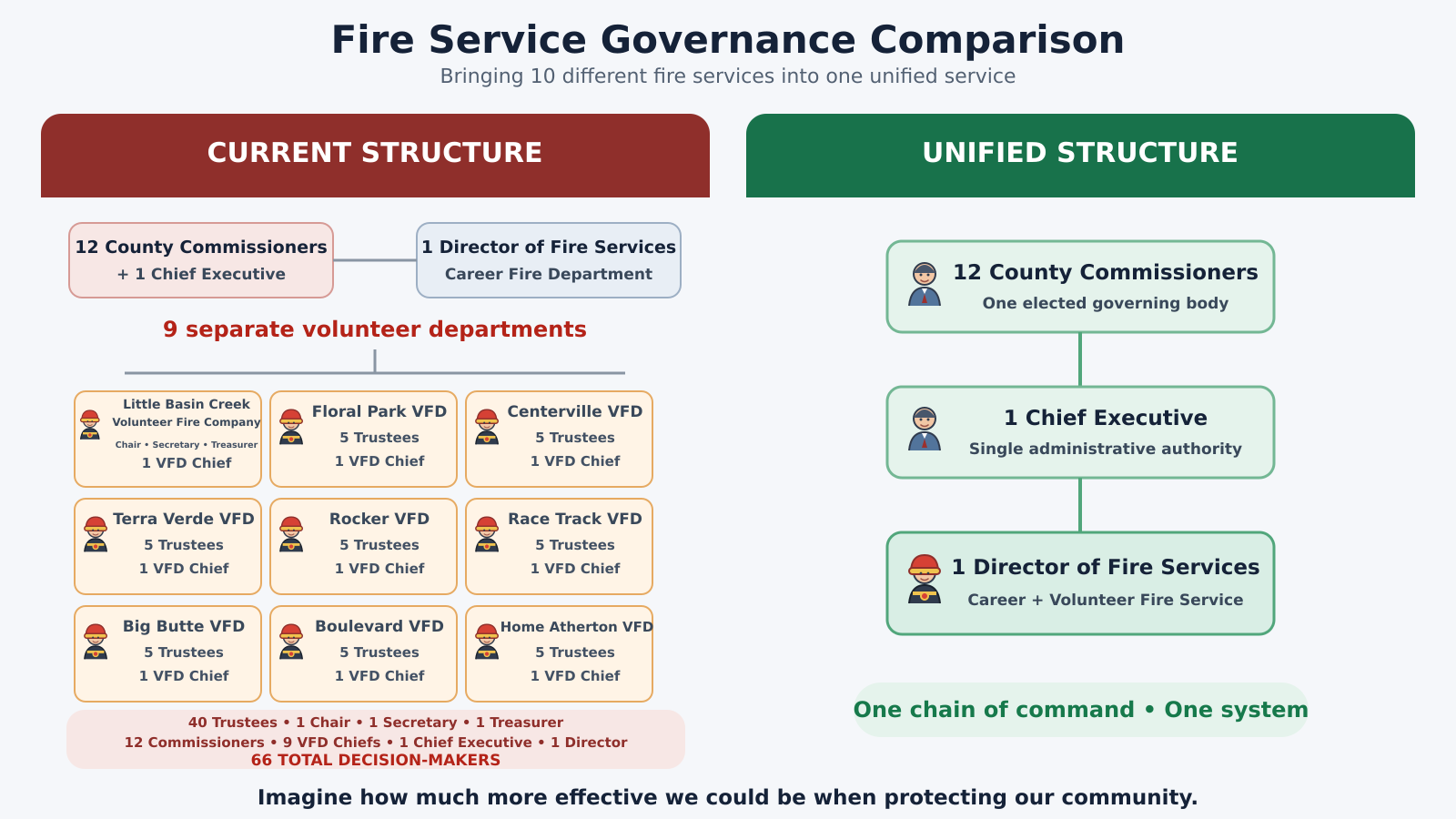
Our current fire service structure was built around nine separate volunteer departments operating alongside the career fire department, each with its own leadership, governance, and decision-making process. The result is not one coordinated fire service—it is multiple independent organizations expected to function together when an emergency occurs.
As the graphic above illustrates, the current structure involves 66 different decision-makers across the system. Separate boards, separate chiefs, separate expectations, and separate organizational priorities create unnecessary layers between the people responsible for governing our community and the firefighters responsible for protecting it. That fragmentation makes it more difficult to establish consistent training standards, coordinate resources, implement countywide policies, maintain accountability, and ensure everyone responding to the same emergency is operating under the same expectations.
The emergency does not care which department's name is on the side of the truck. Neither should our system.
When a structure fire, wildland fire, or major disaster occurs, firefighters must immediately function as one team. There is no time on the emergency scene to reconcile different policies, training expectations, organizational cultures, or chains of command. Firefighters need to know what is expected of one another, who is in command, and that the person working beside them has been trained and prepared to operate to the same established standard.
A unified structure does not mean eliminating the value or contribution of volunteer firefighters. It means bringing career and volunteer firefighters into one coordinated fire service with one administrative structure, one chain of command, common expectations, and a shared mission.
Under a unified system, the elected County Commissioners remain accountable to the public. The Chief Executive provides a single administrative authority. The Director of Fire Services oversees a coordinated career and volunteer fire service. Instead of numerous independent organizations attempting to work together, everyone becomes part of the same system.
The greatest beneficiary to that change is not just the fire service…..
It’s the community we serve!
Collaborating for a Better Future
A unified fire service is about more than changing an organizational structure—it is about building a better future together. Career and volunteer firefighters share the same fundamental purpose: protecting our community when it needs us most.
By working within one coordinated system, we can strengthen relationships, train together, establish consistent expectations, share resources, and learn from one another. Collaboration allows us to preserve the strengths and traditions of our existing departments while addressing the challenges that have developed from operating as separate organizations.
Moving forward requires cooperation, communication, trust, and a willingness to put the needs of the entire community ahead of individual departments. Unification gives us the opportunity to stop operating as separate pieces and start building something stronger together.
This is not about choosing sides or diminishing anyone’s service. It is about recognizing that we are stronger, safer, and more effective when we move forward together—with one mission and one commitment to our community.
Our past may have been built separately. Our future should be built together.
Understanding the Fire Service Ballot Question
Voters will be presented with a significant decision about the future of fire protection in Butte-Silver Bow. The choices ultimately represent three very different directions: maintain the current structure, further separate our fire service, or finally bring it together.
Maintaining the existing Charter language preserves the same fragmented system we have today—multiple departments, separate leadership structures, varying standards, and divided administrative responsibility. It does not address the challenges that have made coordination, accountability, training, and long-term planning difficult.
Removing the volunteer departments from the Charter and allowing them to operate independently would move us even further away from a coordinated countywide fire service. Career and volunteer firefighters would still be expected to respond together to emergencies throughout our community, but the organizations themselves would become more administratively separate. Instead of resolving the problems created by fragmentation, this option risks creating additional questions surrounding coordination, funding, accountability, operational expectations, and long-term responsibility for fire protection.
The unified option provides a fundamentally different path forward.
Under this option, career and volunteer fire services would operate as one unified system under Butte-Silver Bow, with the City-County having operational, administrative, and budgetary authority. Importantly, volunteer firefighters and departments remain part of the system, with a Volunteer Fire Coordinator appointed by the volunteer departments to provide representation and coordination.
Unification does not mean eliminating volunteers. It means eliminating the barriers that prevent all of us from functioning as one fire service.
When an emergency happens, the public expects the fire service to operate as one team. Our governance structure should reflect that same expectation. One system creates the opportunity for clearer accountability, coordinated resources, common operational expectations, consistent training, stronger communication, and long-term planning based on the needs of the entire community rather than individual organizations.
The choice before voters is bigger than career versus volunteer. It is a choice about what kind of fire service Butte-Silver Bow wants for the future.
We can preserve a fragmented system. We can create even greater separation. Or we can bring our firefighters, resources, and leadership together and begin building one coordinated fire service for one community.
When we respond together, we should plan together, train together, and operate together.
One community. One mission. One unified fire service.